What Can a 4 kHz Hearing Loss Pattern Show?
Have you ever been able to hear someone talking but struggled to understand exactly what they're saying?
Perhaps you find conversations difficult in busy restaurants, regularly ask people to repeat themselves, or feel that everyone around you is mumbling.
These difficulties can sometimes happen because hearing loss doesn't affect every sound equally.
At Churchgate Ear Clinic in Ardleigh, near Colchester, I carry out hearing checks to help people understand how well they're hearing different pitches and volumes.
In this case study, I'm sharing a real anonymised hearing-screening result that shows reduced hearing at higher frequencies, particularly around 4 kHz, and explaining what this can mean in everyday life.
What Does 4 kHz Mean on a Hearing Test?
A hearing test measures how quietly you can hear sounds at different pitches, known as frequencies.
These are measured in hertz (Hz).
Lower frequencies represent deeper sounds, while higher frequencies represent sharper, higher-pitched sounds.
4 kHz, or 4000 Hz, is one of the higher frequencies measured during a hearing check.
This frequency is particularly relevant to speech clarity because certain consonants, including s, f, th and sh, contain important higher-frequency sounds.
If hearing at these frequencies is reduced, you may still hear someone's voice but miss some of the smaller sounds that help you understand individual words.
A Real Hearing-Check Example From Churchgate Ear Clinic
One of the hearing-screening examples from my clinic shows an interesting pattern.
The results indicate that hearing is better at lower frequencies but gradually becomes poorer as the pitch increases.
At 500 Hz, the responses were approximately 15–20 dB HL, whereas at 4000 Hz they were around 60 dB HL in both ears.
This means the higher-pitched test sounds needed to be considerably louder before they could be heard.
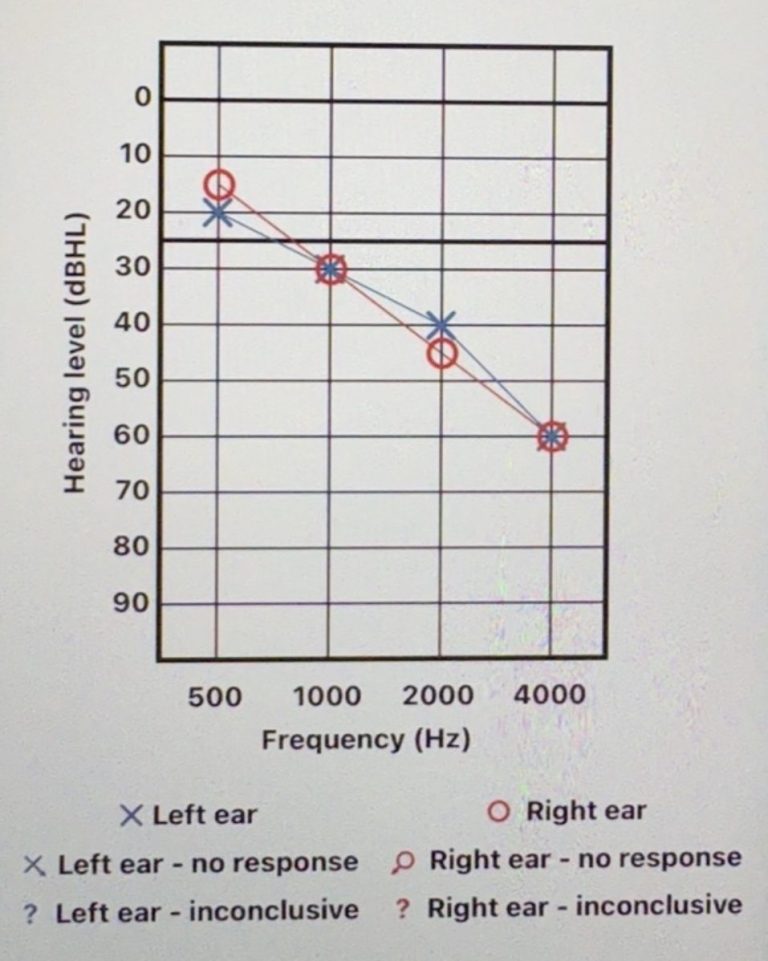
This is an example of a sloping high-frequency hearing loss pattern rather than an isolated 4 kHz notch.
The screening does not establish what caused the hearing change, but it highlights why testing several frequencies can reveal difficulties that might otherwise go unnoticed.
Why Might Someone Hear Speech but Miss Certain Words?
This is something I find particularly interesting about hearing health.
Someone might be perfectly aware that another person is talking but struggle to make out the words clearly.
For example, softer consonant sounds can become difficult to distinguish, especially when there's background noise.
A person with reduced higher-frequency hearing may:
- Hear people talking but feel that they are mumbling
- Struggle to follow conversations in restaurants or groups
- Frequently ask others to repeat themselves
- Find softer voices more difficult to understand
- Turn the television up to hear dialogue more clearly
One of the comments I hear most often during appointments is that someone has started turning the television up, or their family keeps complaining that it's too loud!
Sometimes the problem isn't simply how loudly someone speaks. It's that certain speech sounds are no longer coming through clearly.
Hearing difficulties can also affect more than the sounds themselves. When conversations become tiring or frustrating, some people may start avoiding busy social situations or feel less confident joining in.
That's why I believe understanding changes in your hearing is so important. Hearing well helps us communicate, enjoy conversations and stay connected with the people around us.
Does Hearing Loss at 4 kHz Always Mean Noise Damage?
Not necessarily.
A distinct dip around 4 kHz, sometimes called a 4 kHz notch, is often associated with long-term exposure to loud noise.
However, changes at this frequency can also be associated with ageing, a combination of age and noise exposure, or other factors.
The example shown above has a gradual downward slope towards 4 kHz rather than a clearly isolated notch.
It would therefore be inappropriate to assume that noise exposure caused this particular result.
A hearing screening can highlight a change, but a more detailed assessment with an audiologist may be needed to investigate its cause.
When Might Further Hearing Assessment Be Helpful?
Not every hearing change affects daily life in the same way.
Some people manage well with reduced hearing at certain frequencies, while others find that it makes conversations frustrating or tiring.
Further audiology assessment may be helpful if you:
- Regularly struggle to understand speech
- Find listening in background noise difficult
- Notice that your hearing has gradually changed
- Have a hearing screening showing results outside expected limits
An audiologist can carry out a more comprehensive assessment, including frequencies that aren't covered by my routine screening.
Sudden hearing loss is different and requires urgent medical assessment rather than a routine hearing check.
How I Help Patients Understand Their Hearing Results
At Churchgate Ear Clinic, I believe a hearing check should be about more than simply receiving a result.
I take time to discuss your hearing concerns and examine your ears using modern high-definition otoscopy equipment.
The hearing screening itself takes around ten minutes, and I can show you the results straight afterwards.
I explain the different frequencies and what the pattern may suggest, using everyday language rather than complicated medical terminology.
I like to think of a hearing check as a little MOT for your ears. It gives you a useful picture of your hearing health and helps you keep track of changes over time.
Your hearing-check results are for you. I don't share them with hearing-aid providers, and I have no affiliation with hearing-aid companies, so there's no pressure to purchase anything.
My aim is simply to help you understand your hearing and whether any further assessment would be useful.
Frequently Asked Questions About 4 kHz Hearing Loss
What Is a 4 kHz Hearing Loss?
It means hearing sensitivity is reduced at a frequency of 4000 Hz. The significance depends on how much hearing is reduced and whether other frequencies are also affected.
Is a 4 kHz Notch the Same as High-Frequency Hearing Loss?
Not exactly. A 4 kHz notch is a more specific pattern involving a distinct dip around that frequency. High-frequency hearing loss can affect a wider range of higher-pitched sounds.
Can Hearing Loss Affect Speech Clarity Without Making Everything Quieter?
Yes. Reduced hearing at certain frequencies can make some consonants difficult to distinguish, even when a person's voice is still audible.
Concerned About Your Hearing?
Hearing changes often develop gradually, and it's easy to adapt without realising how much you may be missing.
If you've noticed that conversations are becoming harder to follow, or your family keeps commenting on the television volume, a hearing check can be a useful starting point.
Think of it as an MOT for your ears, helping you understand where your hearing is today and whether anything needs further attention.
At Churchgate Ear Clinic in Ardleigh, near Colchester, I provide independent hearing checks with time to explain your results and answer your questions.
You can learn more about my hearing checks and current pricing, or contact me if you'd prefer to discuss your concerns first.